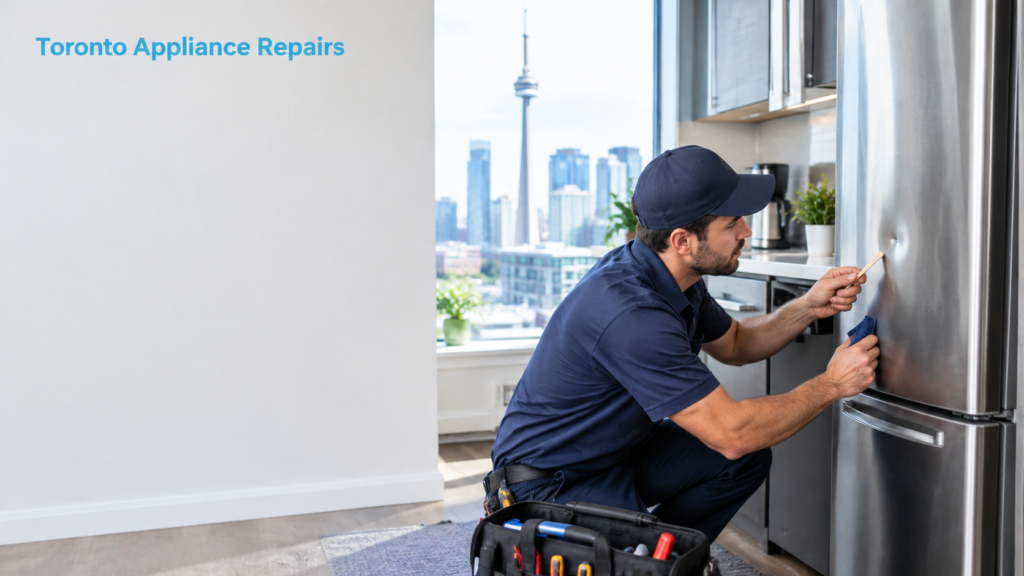
Minor dents in a stainless steel fridge door can often be fixed at home with heat and cold — no body shop visit needed. In Ontario, this technique works on shallow dents under 3 centimetres. Toronto Appliance Repair put this guide together for homeowners who want a cost-effective fix before committing to panel replacement or a professional service call.
Key takeaways
- Minor dents under 3 cm on a stainless steel fridge door respond to the heat-and-cold method: heat the dent for 2 to 3 minutes with a hair dryer, then immediately apply dry ice or an inverted compressed air can to contract the metal back toward its original shape.
- Paintless dent repair (PDR) tools — suction cups, nylon rods, and glue tabs — cost $20 to $80 CAD at Canadian hardware stores and remove most small door dings without scratching the finish or requiring painting.
- Deep creases, sharp-edged dents, and dents near hinges or dispenser panels require professional repair; conventional body repair or panel replacement runs $200 to $600 CAD depending on the model.
- Stainless steel refrigerators provide a sleek, timeless aesthetic and exceptional durability — a visible dent reduces resale value in a market where kitchen appliances finished in stainless steel are desired by home buyers.
- Never sand, grind, or apply painting compounds to a stainless steel fridge door — conventional repair methods used on vehicles cause permanent damage to appliance finishes.

Before you start
Stainless steel refrigerators remain visually appealing over time. Stainless steel has a neutral finish that works well with many kitchen styles — from traditional wood cabinetry to contemporary minimalist layouts. That visual consistency is why a dented fridge door stands out, and why fixing it before a home sale, a tenant inspection, or a kitchen renovation is worth the effort.
The material properties work in your favour here. Stainless steel is completely fireproof and heat-resistant, which makes the hair dryer temperature ranges in this method safe for the surface. The non-porous surface of stainless steel does not harbour bacteria and is easy to disinfect after the repair — no finish damage from cleaning agents between steps. Stainless steel also resists dents, scratches, corrosion, and rust, which means the surrounding finish holds up during the repair process even with tape and suction tools applied.
If the dent is accompanied by other symptoms — a door seal that no longer seats flush, a unit that is running warm on the exterior cabinet on the exterior cabinet, or unusual sounds following the impact — do not proceed with cosmetic repair. Book refrigerator repair in Toronto first. A diagnostic visit confirms whether the sealed system was involved before any panel work is attempted.
What you need
- A standard household hair dryer
- Dry ice — available at major grocery stores and select hardware stores across Ontario for approximately $1.50 to $2.50 CAD per pound — OR an inverted can of compressed air (available at office supply stores for $8 to $14 CAD)
- A suction cup dent puller or a standard bathroom plunger
- Painter’s tape
- Clean microfibre cloths
- Mild dish soap and warm water for surface cleaning before starting
- Thick rubber or leather gloves for handling dry ice
- Nylon rod or wooden dowel if the panel can be accessed from the inside
Optional: a commercial paintless dent repair (PDR) kit with calibrated glue tabs and a slide hammer — available at Canadian Tire or specialty auto supply stores for $30 to $90 CAD — for larger or off-centre minor dents that a standard suction cup cannot fully cover.
Safety and prerequisites
Clean the dent area with mild dish soap and warm water before starting. Grease and fingerprints reduce suction cup adhesion and make it harder to track how the dent is responding to heat and cold during the process.
Handle dry ice with thick gloves at all times. Contact with bare skin causes frostbite within seconds. Never store dry ice in a sealed container or enclosed space — it releases CO2 as it sublimates and can cause pressure buildup in confined areas.
Keep the hair dryer in constant motion over the stainless steel surface and hold it no closer than 10 cm from the door panel. Concentrated heat in one position can warp the finish or cause discolouration, particularly on fingerprint-resistant stainless steel models where the surface coating is thinner than on standard finishes.
If the dented panel is the freezer door, unplug the unit before starting. The thermal method works on an unplugged appliance and removes any electrical risk near the door gasket and internal wiring.
Step-by-step
The heat-and-cold method works by expanding the stainless steel with heat, then rapidly contracting it with cold — the thermal differential causes the metal to flex back toward its original position. Most minor dents respond within two to three complete cycles. Larger or partially-creased dents may need the suction method in Step 3 as a follow-up.
Step 1: Clean the surface and apply heat
Wipe the dent area with a microfibre cloth and mild dish soap, then dry thoroughly. Apply painter’s tape around the perimeter of the dent to protect the surrounding finish from contact during the repair.
Set the hair dryer to its highest heat setting. Hold it 10 to 15 cm from the stainless steel surface and move it in slow, overlapping circular passes directly over the dented area for 2 to 3 minutes. Do not pause in one position. The goal is uniform heat across the entire dent — not a concentrated hot spot at the centre.
The surface should feel warm to the touch when the hair dryer is pulled away — warm enough to notice clearly, not hot enough to hold your hand against for more than a second. A subtle sheen may develop on the stainless steel as it heats. That is the visual cue that the metal is ready for the cold application in Step 2.
Step 2: Apply cold immediately
Prepare the cold material before the hair dryer reaches the 2-minute mark so the transition from hot to cold happens without delay. If using dry ice: grip it firmly with thick gloves and press the flat side directly against the centre of the heated dent. Hold steady contact for 30 to 60 seconds. If using an inverted compressed air can: hold the can upside down and spray the liquid propellant directly onto the dented area for 30 to 60 seconds — the propellant exits at a very low temperature and chills the stainless steel surface rapidly.
The thermal shock — the rapid shift from heated expansion to cold contraction — causes the metal to flex. In many cases the dent audibly pops back toward its original position. If that happens, proceed directly to Step 4.
If the dent has partially improved but remains visible, allow the panel to return to room temperature — approximately 10 to 15 minutes — before repeating the full cycle from Step 1.
If it does not work the first time
Allow the panel to cool fully to room temperature before repeating. Attempting a second thermal cycle while the metal is still contracted from the cold reduces the temperature differential and limits the method’s effectiveness. Most minor dents on stainless steel respond within two to three full cycles. A dent that shows no movement after three complete attempts is unlikely to respond further to this method and requires a suction tool or professional paintless dent repair.
Most common cause of failure
The most common reason the heat-and-cold method fails is insufficient heat duration in Step 1. The hair dryer must run for the full 2 to 3 minutes with consistent circular motion across the entire dent. A 30 to 40 second pass feels like enough heat but rarely produces the temperature differential required to move stainless steel.
Stop here if you see this
If the stainless steel develops a blue, yellow, or brown discolouration during heating, stop immediately and allow the panel to cool. Discolouration means the finish has exceeded a safe temperature range and has been permanently altered — continued heating will not reverse it.
Step 3: Apply suction if the dent is still present
If the thermal method produced partial improvement but a visible depression remains, a suction tool is the next step.
Dampen the rubber cup of a suction dent puller or a standard bathroom plunger with a small amount of water to improve the seal. Centre the cup directly over the remaining dent and press firmly to create a tight seal against the stainless steel. Pull straight outward with steady, even pressure for 3 to 5 seconds, then release. Avoid twisting or jerking — the goal is controlled outward tension, not a sharp pull.
Repeat 4 to 6 times, shifting the cup position slightly between each attempt to work different edges of the dent. This technique mirrors what paintless dent repair technicians at body shops call working the metal from the outside. It is less precise than accessing the panel from the inside with nylon rods, but it is effective on rounded, shallow dents where the metal has not creased.
For additional techniques specific to stainless steel fridge panels, the guide on removing dents from a stainless steel fridge covers methods and outcomes in detail.
Step 4: Finish and verify
Once the dent has responded to either method, remove the painter’s tape slowly and examine the repaired surface under direct light. A work lamp or phone torch held at a low angle to the door face reveals low spots and ripples that a flat overhead light will not show. Any remaining irregularity is visible at this angle — address it with an additional suction pass if needed before cleaning up.
Wipe the area with a clean microfibre cloth dampened with warm water to remove dry ice residue, suction marks, soap film, and fingerprints. Many modern stainless steel variants have a smudge-proof finish — check your model’s care guide to confirm whether a stainless steel appliance cleaner is recommended for your specific surface. Traditional stainless steel shows smudges and watermarks easily, so finish with a dry microfibre cloth to prevent water spotting on the repaired panel.
Note that most stainless steel surfaces allow magnets to stick — test a magnet on the repaired area to confirm the surface properties are consistent with the rest of the door. A panel that has been severely overheated can sometimes lose magnetic receptivity.
Check that the door gasket seats properly and the door closes with the same resistance as before the impact. The thermal process should not affect the gasket, but confirming this takes 10 seconds and prevents cold air loss from an unseated seal going unnoticed.
For a routine that preserves the stainless steel finish between service visits, follow the guidance on keeping your fridge clean — a consistent cleaning routine prevents new marks and protects the finish quality after the dent has been addressed.

When DIY stops being sensible
The heat-and-cold method and suction tools cover most minor dents and small door dings on a stainless steel fridge door. Several conditions put the job outside what home repair can safely address.
A dent with a sharp crease — a visible fold in the metal rather than a rounded depression — has exceeded the material’s elastic limit. The stainless steel has permanently yielded in that area and cannot be returned to its original position with thermal methods or suction. Conventional repair techniques used in body shops can address sharp creases, but those approaches require specialized tools, trained technicians, and in some cases panel replacement.
Hail repair on a stainless steel fridge that sustained multiple impact points — common after a door-open incident in a storm or a move with inadequate padding — requires systematic work across the panel. Multiple simultaneous dents change the structural load on the panel and need a technician with appropriate equipment working in a controlled sequence.
Dents adjacent to hinge mounting points, handle hardware, ice dispensers, or water dispenser panels carry structural and electrical risk. These areas contain wiring, plumbing connections, or load-bearing fasteners. Applying heat or suction near those components without proper disassembly risks damaging the dispenser assembly or shifting the hinge alignment permanently.
If the fridge is running unusually warm after the impact, it may indicate more than a cosmetic problem. A fridge that feels warm on the exterior cabinet is worth investigating before any panel work begins.
Any dent accompanied by a door seal that no longer closes flush, or sounds from the cooling system after an impact, means the unit took more than surface damage. Book refrigerator repair in Toronto and describe both the impact and the current symptoms — a technician will assess the sealed system and compressor before scheduling any panel work.
For compact and bar-size stainless steel refrigerators, the same decision rules apply, though the panels are smaller and often easier to access. See the guide on what to do when a mini fridge stops working for guidance specific to smaller stainless steel units.
What a Toronto professional does differently
Toronto Appliance Repairs technicians approach a stainless steel fridge dent as a panel repair, not a vehicle body shop job. The distinction matters in practice: conventional body repair on a car uses grinding, filler, and painting — all of which permanently damage an appliance stainless steel surface. Appliance panel repair requires different hand tools and methods suited to the material and the finish.
For dents that respond to heat and suction, technicians use hand tools suited to the finish — working from the inside of the door panel with controlled force where the design allows. These approaches produce better results on deeper or off-centre dents than household suction cups achieve, and they work without introducing the risk of finish damage from excessive heat or abrasive contact.
When panel damage cannot be addressed through those methods, a technician will assess whether the door assembly requires service and confirm the options and pricing on the visit.
Every service visit covers the complete door system. Many stainless steel refrigerators include Wi-Fi connectivity and smart-home compatibility, adjustable shelving and flexible drawers that organise different food sizes, LED lighting for interior visibility, and water and ice dispensers. A technician confirms all door-adjacent features are working correctly after any panel repair. ENERGY STAR certified refrigerators use about 9% less energy on average — a door seal that seats correctly after a panel repair restores that efficiency. Written service reports are available on every visit, which is useful for insurance documentation when a fridge was dented during a move or a renovation.
Frequently asked questions
Common questions Ontario homeowners ask about dent repair on stainless steel refrigerators.
Can you fix a dent in a stainless steel fridge door at home?
Yes. Minor dents under 3 cm respond to the heat-and-cold method: heat the dent with a hair dryer for 2 to 3 minutes, then apply dry ice or inverted compressed air to contract the metal. Most small door dings on a stainless steel fridge pop out in one to three attempts. Deep creases and dents near hinges or dispenser panels require a professional.
What is paintless dent repair on a stainless steel refrigerator — and how does it compare to body shops?
Paintless dent repair (PDR) uses suction tools, glue tabs, and nylon rods to restore metal to its original shape without grinding or painting. Body shops use similar methods on vehicles, but appliance PDR avoids the abrasives and high heat levels that would permanently damage stainless steel surfaces. It works on rounded, shallow dents and most small door dings on major appliances.
Do stainless steel refrigerators qualify for dent-discount pricing from major appliances retailers in Canada?
Some Canadian retailers sell dented major appliances at a reduced sale price — listed as closeout products, refurbished products, or open-box units with a visible cosmetic fault. Availability and quantities are limited, and substitute models may qualify for similar discounts. Confirm dimensions and colour selection before purchasing, as discontinued major appliances may have limited parts availability for future service needs.
Is it worth repairing a dent, or should I choose the right refrigerator and replace it?
Repair is the right call when the dent is minor and the fridge is under 10 years old. Stainless steel refrigerators range from 24 to 36 inches wide and cost $800 to $3,000 CAD to replace — a panel repair or PDR visit at $150 to $400 CAD is the sounder financial decision for most Canadian residents. Replace only when mechanical faults also exist.
About Toronto Appliance Repair
Toronto Appliance Repairs serves Ontario homeowners, tenants, and landlords with refrigerator repair and full appliance service across Toronto and the GTA. Technicians carry commonly needed parts for all major brands — LG, Samsung, Whirlpool, GE, Bosch, KitchenAid, Frigidaire, and Electrolux.
Stainless steel refrigerators are available in multiple configurations — French door, bottom freezer, counter depth, and side-by-side models — each with different panel alignment and hinge torque requirements on installation. Counter depth stainless steel refrigerators fit flush with kitchen cabinets; trained technicians ensure the door seal meets the manufacturer’s specification after any repair.
Many stainless steel models offer water and ice dispensers for convenience, and many stainless steel refrigerators are equipped with LED lighting that technicians verify after any panel work. Fingerprint-resistant finishes reduce visible smudges and marks — and many brands offer fingerprint-resistant stainless steel options that require specific cleaning products after a repair to maintain the coating. Upfront pricing is confirmed before work begins. No hidden fees. Book refrigerator repair in Toronto with Toronto Appliance Repairs for same-day service across the GTA.
Service area
Toronto Appliance Repairs provides refrigerator repair and full appliance service across Toronto and surrounding municipalities, including North York, East York, Scarborough, Etobicoke, Mississauga, Richmond Hill, Markham, and Aurora. Contact Toronto Appliance Repair to confirm same-day availability in your area before booking.
Next step
Book refrigerator repair in Toronto with Toronto Appliance Repairs today. A technician diagnoses the fault on the same visit and confirms a repair quote before any work begins. No hidden fees.
For a full list of appliance repair and installation services across Toronto and surrounding areas, visit Toronto Appliance Repair services.